

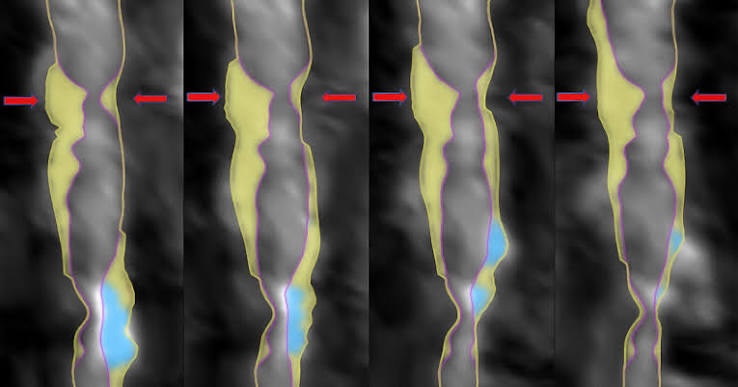
A calcium score test is basically a fancy X-Ray of the heart: It is a low-dose CT scan of the heart that is looking for evidence of plaque that has been inside the arteries for so long that it has had time to fossilize, or “harden”. Coronary artery disease develops when cholesterol-rich plaque accumulates within the walls of the arteries supplying blood to the heart. At first, the plaque is “soft” but hardens and calcifies over the course of years and decades.
Historically, we thought of atherosclerosis as a largely progressive disease, and our goal was to slow it down and stabilize it, thereby preventing cardiac events.
So when we see patients in the office after these scans, they are typically disappointed and depressed to know that they have calcified plaque, thinking that it is already “too late” and there is nothing that can be done about it.
So when I tell them that not only do we have interventions that can lower the risk of heart attack, but that can also “melt away” plaque, they are almost always surprised by the wording I use.
But over the past 20 years, research has shown us just this. With aggressive cholesterol reduction, we can do more than simply stabilizing plaque: we can actually shrink some of the plaque that’s already there.
A recent study published in JAMA Cardiology provides even more evidence of our ability to melt plaque away.
This study, called the FLOWPROMOTE trial, showed that we can actually reverse plaque accumulation. And perhaps more importantly, it supports earlier research that shows that the lower we get LDL cholesterol, the more plaque regression we see.
In this recent trial, researchers in Denmark enrolled 104 patients with newly diagnosed coronary artery disease who had not previously been treated with cholesterol medications.
These patients all had significant coronary artery disease documented by coronary CT angiography (CCTA), which is an advanced imaging test that can actually see into the arteries of the heart, and can find both soft AND calcified plaque (as opposed to a Calcium Score which can only identify “hard” plaque).
Patients in this trial were randomly assigned to one of two treatment groups:
- Group 1: Atorvastatin 40 mg daily, a typical cholesterol-lowering regimen.
- Group 2: Rosuvastatin 40 mg plus ezetimibe 10 mg daily, a more aggressive cholesterol-lowering regimen.
The researchers performed these special coronary CT angiograms at the beginning of the study, after 9 months, and again after 18 months, allowing them to measure whether the total amount of plaque within the coronary arteries actually changed with treatment over the course of the trial..
Both treatment strategies effectively lowered LDL cholesterol: Patients on Atorvastatin (A) got their LDL-C down to 70 mg/dL, and those on rosuvastatin plus ezetimibe (R + E) achieved an LDL-C of 43 mg/dL!
After 18 months, patients on the R + E “aggressive” regimen experienced a reduction in total plaque of 21.1% (compared to 13.6% in the atorvastatin alone group) and a 28.2% reduction in the amount of “soft” plaque (compared to 20% in the atorvastatin alone group).
So both groups experienced plaque regression, but the patients receiving more intensive cholesterol-lowering therapy experienced significantly greater reduction in total plaque and “soft” plaque.
Importantly, 98% of patients receiving the “aggressive LDL lowering” regimen of rosuvastatin plus ezetimibe experienced at least some degree of reduction in “soft” plaque.
When they dove deeper into the data, the researchers also found that the lower the LDL-C level achieved, the greater the reduction in plaque.
Of course, the idea that we can actually reverse some coronary plaque accumulation isn’t entirely new.
As far back as 2006, researchers published the “ASTEROID” trial, which demonstrated that patients treated with high-dose rosuvastatin experienced measurable reductions in coronary plaque over two years.
In 2011, the “SATURN” trial confirmed that aggressive treatment with either atorvastatin or rosuvastatin could produce plaque regression in a majority of patients.
But perhaps the best evidence came from the “GLAGOV” trial in 2016. Researchers added a powerful cholesterol-lowering medication called evolocumab (“Repatha”) to statin therapy, achieving average LDL cholesterol levels of just 37 mg/dL.
Not only did the patients in this trial experience greater plaque regression, but researchers found that the relationship between LDL cholesterol and plaque regression appeared to continue even at LDL levels as low as 20 mg/dL!
More recent studies have demonstrated that aggressive LDL lowering can also change the composition of coronary plaque, reducing its lipid content and increasing the thickness of the protective fibrous cap, which may help make plaque less vulnerable and less likely to rupture and cause a heart attack..
This means that the results of FLOWPROMOTE were actually very consistent with what we’ve learned over the past two decades: Lowering LDL cholesterol doesn’t just slow the progression of coronary artery disease; with sufficiently aggressive treatment, we can actually “melt away” plaque that is already there.
And the lower we get LDL, the greater the benefit.
Another thing that this study showed was that the amount of calcified plaque actually increased in both treatment groups. While at first glance, this might sound concerning, it may not be at all. Calcium is only one component of atherosclerotic plaque. We know from previous research that statin treatment can actually increase the calcification and density of existing plaque, even as it reduces the amount of cholesterol-rich material within the arterial wall. This is thought to represent a process of plaque stabilization, in which some of the more vulnerable plaque becomes denser and less likely to rupture. And we also know that most heart attacks come from rupture of the “soft” plaque.
In other words, an increase in coronary calcium during cholesterol treatment doesn’t necessarily mean that coronary artery disease is getting worse. (By the way, this is one reason why repeating coronary calcium scores is really not recommended).
So what does this new study tell us?
It reminds us that aggressive LDL lowering can reduce plaque volume, and not just slow its progression. It reminds us that lower achieved LDL-C levels are associated with greater plaque regression. And it once again shows that LDL lowering can change plaque composition, potentially making plaques more stable and less likely to rupture.
FLOWPROMOTE adds to a growing body of evidence that shows that coronary atherosclerosis is not necessarily an irreversible process. With aggressive LDL cholesterol reduction (either by medications or lifestyle improvement), we may actually be able to melt away the plaque that has accumulated within the coronary arteries.
So we now have even more proof that it’s never too late to take meaningful steps toward improving the health of your arteries.
At Wisconsin Cardiology Associates, we specialize in advanced methods of risk assessment, and can guide you through the process of evaluation. Have questions about the best way you can evaluate your risk of heart disease? Call us and make an appointment for a consultation.
