

Balanced or Biased?
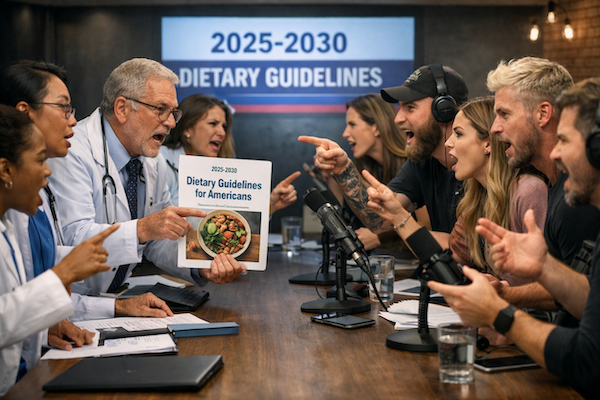
In this hyper-polarized and partisan world that we currently find ourselves in, it is easy to fall into the trap of seeing everything that happens as 100% good and correct or 100% horrible and proof of the end of the world.
The truth is almost always somewhere in the middle.
This same concept holds true for the 2025-30 Dietary Guidelines for Americans (DGA) update that was just announced by the Federal Government.
It may seem to you that this is just another fairly meaningless government pronouncement and has no impact on your life.
But the DGA, which the federal government updates every five years and released on Jan. 7, 2026, is actually much more important than merely a set of suggestions. These guidelines shape the meals served in schools, inform federal food assistance programs, and influence nutrition labeling and education.
These new guidelines typically include science-based recommendations — such as increasing intake of vegetables, fruits and whole grains while limiting consumption of added sugars, refined grains and ultra-processed foods.
So why did these new Guidelines make news? And what were the headlines?
The headlines you may have seen were the ones that reported that beef, tallow and whole fat dairy were “back”. At the press conference, RFK Jr stated “We are ending the war on saturated fats.”
But beyond the catchy headlines, what 2025–2030 Dietary Guidelines for Americans really do is emphasize eating whole, nutrient-dense “real” foods—prioritizing high-quality protein, healthy fats, fruits, vegetables, and whole grains while dramatically reducing highly processed foods, refined carbohydrates, added sugars, and unhealthy additives.
In this new guideline, the familiar MyPlate approach has been replaced with a new “food pyramid” that inverts traditional food guidance, giving greater visual prominence to meat, dairy, and fats alongside fruits, vegetables, and whole grains.
Protein is now emphasized at every meal, with higher recommended intakes and inclusion of a broader range of animal and plant proteins. Healthy fats from whole-food sources (including full-fat dairy and natural fats like butter) are highlighted.
My thoughts? In some ways, these are the best guidelines that have been released in the last 45 years.
Why? Because the main message of the guidelines is “EAT REAL FOOD”.
For once, attention is being paid to the fact that most of the calories consumed in this country come from ultra-processed foods. A report from 2024 stated that 73% of America's food supply is made up of ultra-processed foods, and that these foods comprise 60% of the typical adult's diet. Large prospective cohort studies show that each ~10% increase in calories from ultra-processed foods is associated with ~10–15% higher risk of cardiovascular disease, including heart attacks and strokes. In tightly controlled feeding trials, participants eating ultra-processed diets consumed ~500 more calories per day and gained weight compared with unprocessed diets—despite identical macronutrient composition—accelerating cardiometabolic risk.
These foods are causes of the rise in obesity and diabetes in this country, and the reason why so many of us have to turn to expensive injectable medications to turn our health back around.
So it is a victory that the official guidelines for nutrition in this country now recognize that we need to focus on minimizing or removing processed foods.
But I do of course have concerns with the guidelines. They place a heavy emphasis on animal protein (including a recommendation to double protein intake) and saturated fats like butter and tallow. There is strong science, accumulated over decades, demonstrating that replacing saturated fat with unsaturated fats, primarily polyunsaturated fats, decreases risk of many chronic diseases. It is true that replacing saturated fat with carbs does NOT lead to better health, so what we replace the saturated fat with matters. But increasing saturated fat overall does not lead to better health.
As the American Heart Association stated in their press release: “the new guidelines' emphasis on seasoning food with salt, eating animal protein and whole-fat dairy, and cooking with beef tallow and butter could lead to excessive consumption of saturated fats and sodium, which are primary drivers of cardiovascular disease.”
Part of the problem with this new guideline is that it is not internally consistent. The authors raised the prominence of meat, eggs and full-fat dairy, but kept the 10% recommended daily limit on saturated fat. If you actually try to plan a meal with the new recommendations, you blow through that 10% saturated fat limit every time.
But an even bigger problem is how they were created, and by whom.
Normally, the Dietary Guidelines for Americans (DGA) are developed through a structured, recurring 5-year process led by the U.S. government. The process is jointly overseen by the U.S. Department of Agriculture (USDA) and the U.S. Department of Health and Human Services (HHS). Every 5 years, USDA and HHS appoint a Dietary Guidelines Advisory Committee (DGAC)—typically 20–25 independent scientists with expertise in nutrition, medicine, epidemiology, and public health. These members are screened for conflicts of interest and their role is scientific advice only (they do not write policy). This Advisory Committee evaluates the best available science and assesses links between dietary patterns, foods/nutrients, and health outcomes. Historically, there is an incredible amount of transparency with this process: the Advisory Committee meetings are public and webcast, the draft conclusions are released, and public comments are solicited from clinicians, researchers, industry, advocacy groups, and citizens. After this rigorous process, the Advisory Committee then delivers a comprehensive DGAC Scientific Report to USDA and HHS. This report summarizes the evidence and provides recommendations, but it is not policy, just recommendations.
The USDA and HHS then subsequently translates those recommendations into official policy: The Dietary Guidelines for Americans, a document that integrates the science with federal nutrition policy considerations, ensuring consistency with existing laws and programs (e.g., school meals, SNAP, WIC).
Unfortunately, that process (which had been followed for decades) was upended in this cycle. HHS, led by RFK Jr, decided to create another committee, which introduced a separate “Scientific Foundation for the Dietary Guidelines for Americans” report, in competition with the Advisory Committee report.
Unfortunately, there has been a total lack of transparency regarding the methods, approaches, and objectives of this alternative committee.
As the American Society for Nutrition stated in their press release:
“[The] ASN is concerned that departing from the established scientific review process undermines confidence in the DGAs and nutrition science, contributes to confusion and distrust, and obscures the opportunity for meaningful scientific discourse.”
If we dive deeper into this report from the “Scientific Foundation for the Dietary Guidelines for Americans” we see that it was created by a panel of 9 individuals, eight of whom had huge conflicts of interest, including:
• Benjamin Bikman, PhD, co-owner of HLTH, a high-protein meal replacement brand with whey, egg whites, and hydrolyzed grass-fed collagen, as well as advisor for Nutrishus Brands, which sells high protein “Keto-certified products” made with milk protein;
• J. Thomas Brenna, PhD, who has declared financial relationships with Global Dairy Platform, National Cattlemen’s Beef Association, North Dakota Beef Council, Texas
Beef Council, General Mills, and American Dairy Science Association;
• Michael Goran, PhD, who has financial relationships with the Robert C. And Veronica Atkins Foundation;
• Donald Layman, PhD, FASN, who has financial relationships with National Cattlemen’s Beef Association, National Dairy Council, and American Egg Board;
• Heather Leidy, PhD, FASN, who has financial relationships with National Cattlemen’s Beef Association, Egg Nutrition Center, National Pork Board, General Mills, and Novo Nordisk (makers of Ozempic)
• Ameer Taha, PhD, who has financial relationships with California Dairy and Dairy Management Inc.
• Jeff Volek, PhD, RD, a scientific advisor for Simply Good Foods who has financial relationships with National Dairy Council and Atkins Nutritionals and who is a Founding member of Virta Health (a weight loss company that advocates for keto diets)
So can it be any surprise that these individuals recommended an emphasis on more animal protein and fat in our diets? Can we really trust that people with these financial conflicts were neutral evaluators of nutrition research?
The official Advisory Committee provided rigorous, evidence-based recommendations to improve population health and reduce chronic disease risk. Its conclusions—based on decades of dietary data—emphasized limiting red and processed meats, added sugars, sodium, and ultra-processed foods in favor of fruits, vegetables, whole grains, legumes, nuts, and plant-based proteins.
But the final official policy document released this week (“2025–2030 Dietary Guidelines for Americans”) deviated substantially from these evidence-based recommendations. The new Dietary Guidelines ignored the recommendations of the Advisory Committee and relied instead on the recommendations of a hastily assembled panel of scientists with financial ties to the meat, dairy, and fad diet industries.
So when evaluating these new Dietary Guidelines, what are we left with? Like most other things in this world, the truth is somewhere in the middle. We should all definitely celebrate the fact that the Dietary Guidelines are recommending, for the first time ever, a diet lower in highly processed and ready to eat food, refined grains, added sugar, sugary beverages, cookies, candy, chips, and foods with artificial sweeteners, preservatives, dyes, and colors. The emphasis on these beneficial changes truly represents progress, and is long overdue.
But… these guidelines are wrong in their focus on increasing animal protein and fat, and the authors were clearly biased by their significant financial conflicts-of-interest with animal-product and low-carb companies.
As I stated earlier, there is strong science, accumulated over decades, demonstrating that replacing saturated fat (mostly found in animals) with unsaturated fats (mostly found in plants), decreases risk of many chronic diseases.
So what changes should YOU make in your diet?
The science still shows that the best approach is the approach described by the author Michael Pollan:
“Eat food. Not too much. Mostly plants.”
At Wisconsin Cardiology Associates, we counsel our patients to aim for a healthy, plant-based diet, emphasizing fruits, vegetables, beans, lentils, whole grains and nuts.
Have questions about the best way you can prevent heart disease? Call us and make an appointment for a consultation.
Our clinic is open and we are accepting new patients
